
30 years after Hurricane ʻIniki devastated Kauaʻi, the memories of the storm remain fresh — but the disaster relief lessons carry Hawaiʻi Foodbank’s mission forward.
Sept. 11, 1992 — It’s hard to believe it has been 30 years since that cataclysmic day. When Hurricane ʻIniki visited Kauaʻi, it changed everything. Packing winds in excess of 145 mph, ʻIniki swept across the island, leaving behind the worst disaster in the history of the State of Hawaiʻi. ʻIniki was fierce, and it really presented giant problems for our tiny island.
Six deaths. More than 100 people injured. Thousands of tourists stranded. Nearly 1,500 homes destroyed, and more than 90% of the island’s buildings damaged. Billions of dollars in losses. The Category 4 hurricane ripped off roofs, uprooted trees and knocked out utility pulls — cutting off water, electricity and all communications systems islandwide. It took months to restore power, and many families spent the holidays in the dark.
I cannot tell you how many families have told me about how they huddled together in the bathtub or under a mattress, praying for the storm to pass.
For all of us on the Garden Island, we’ve become intrinsically connected to this storm in one way or another. Myself, I’ll never forget the blare of the warning sirens, the boarded windows, the frantic lines of unmoving cars, and the grocery stores packed with people — but barren of groceries.
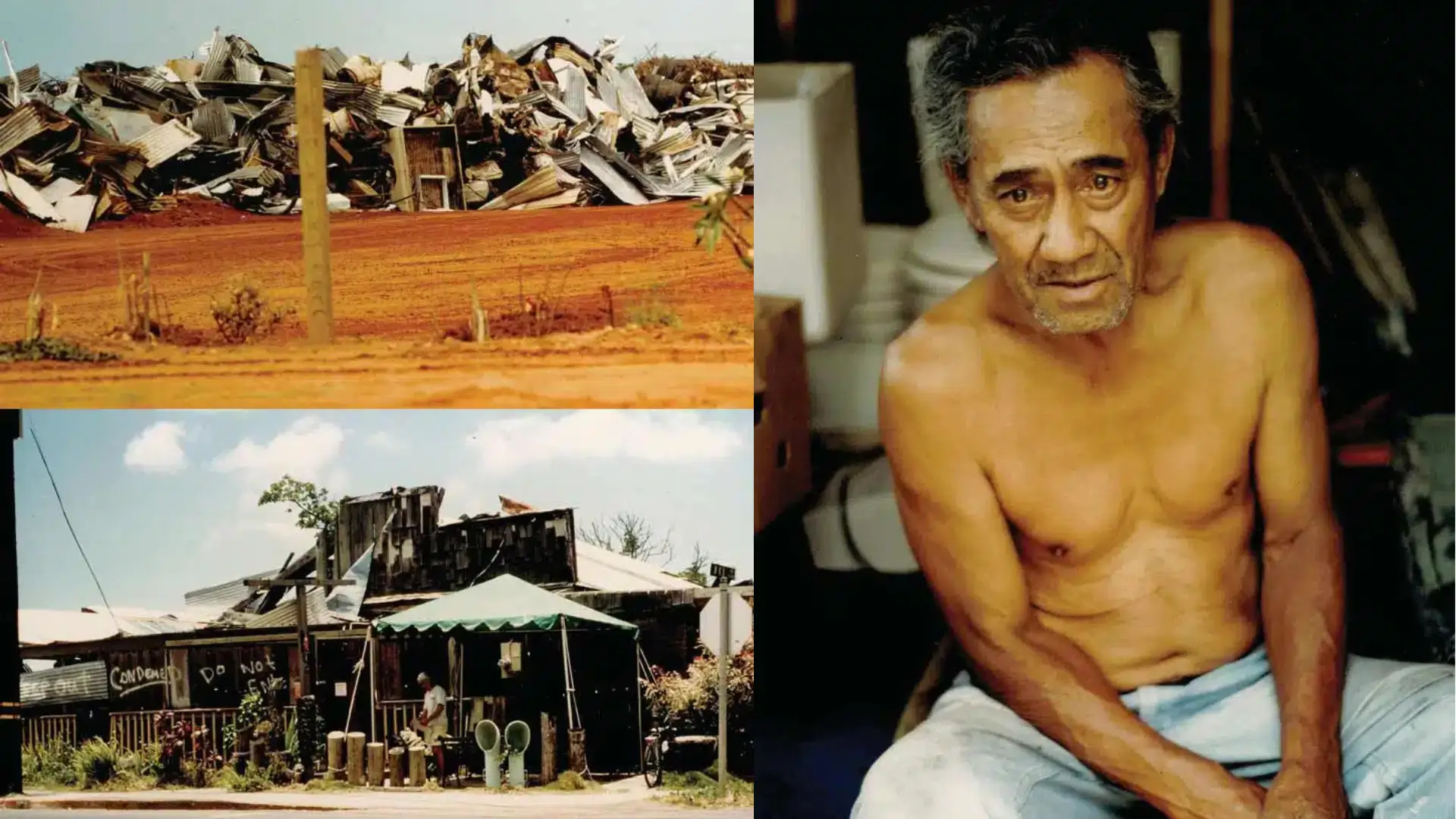
There are tens of thousands of stories to tell about that day and the events that followed. I cannot tell you how many families have told me about how they huddled together in the bathtub or under a mattress, praying for the storm to pass. You might hear stories like Richard’s (pictured lower right), who had to live in a discarded trailer with a makeshift roof after losing his home. Folks might recall the Shell House (pictured lower left), the popular Hanalei spot frequented by locals and visitors alike — until it was destroyed by ʻIHurricane Inikiki. And then there are Aunty Maria and Aunty Eugenia (pictured on the cover), who patiently waited for hours by the roadside every single week after the storm to receive food at Līhuʻe Lutheran Church.
For Hawaiʻi Foodbank, ʻIniki is a story of beginnings.
Prior to ʻIniki, there weren’t any food banks on Kauaʻi. This brought to light an extremely important issue that surfaced in the days, weeks and months following the storm: Kauaʻi’s food infrastructure wasn’t adequately prepared for an emergency of this proportion. Tremendous amounts of food were lost because there was no electricity to power the island’s refrigerators and freezers. Local restaurants, grocers and distributors raced to give away most of their cold-storage products, but that could only sustain the community for so long without power.
The day before ʻIniki struck, Hawaiʻi Foodbank, which was operating primarily out of its Oʻahu warehouse on Kalani Street, was already beginning to anticipate and prepare for emergency. The team implemented a disaster relief plan and initiated a statewide food collection effort with drop-off locations at all fire stations and many banks. Incredibly, in just a few days, the food drive collected nearly 1.7 million pounds of food — exceeding the capacity of the warehouse at that time. With help from the governor, Hawaiʻi Foodbank secured an additional 150,000 square-foot building near the airport. This location would serve as an integral staging, sorting, packing and shipping facility for the ʻIniki relief efforts.
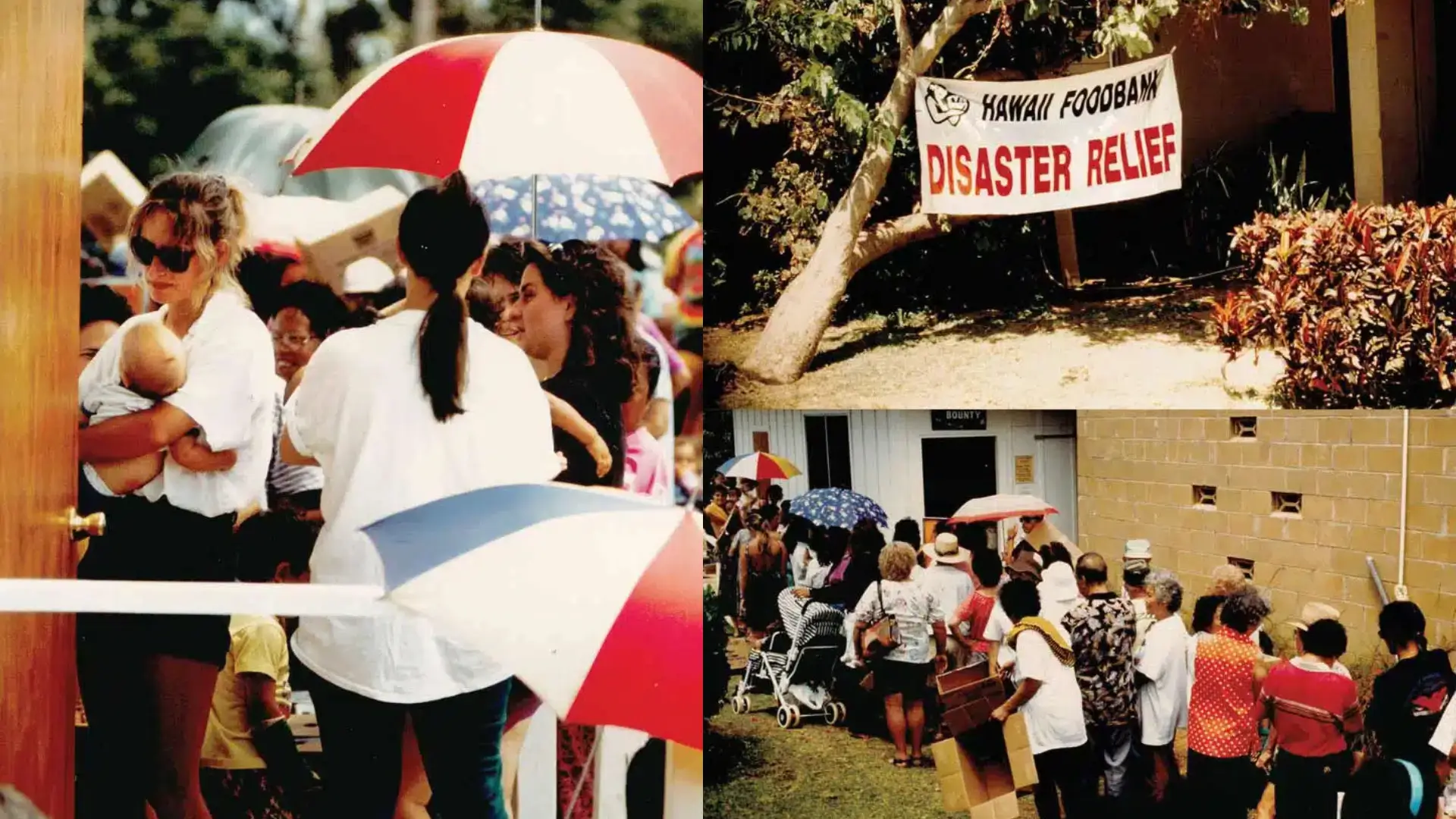
With the help of more than 1,000 volunteers, Hawaiʻi Foodbank immediately palletized and shipped 1.5 million pounds of food to Kauaʻi. Over the course of the next year, Hawaiʻi Foodbank distributed roughly 5 million pounds of food to an average of 12,000 people each month — a quarter of the population of the Garden Island. For more than 70% of those people, this was the first time they ever had to ask for food assistance.

With the help of more than 1,000 volunteers, Hawaiʻi Foodbank immediately palletized and shipped 1.5 million pounds of food to Kauaʻi.
This was all accomplished in cooperation with the American Red Cross, The Salvation Army and more than 20 other voluntary organizations. In collaboration with these partners, a food distribution network was created on Kauaʻi along with five emergency distribution sites to provide extra aid.
Hawaiʻi Foodbank’s ʻIniki relief efforts garnered national attention and set a model for food bank disaster relief across the country. This laid the groundwork for Hawaiʻi Foodbank to work with America’s Second Harvest — now known as Feeding America — in establishing food banks as legitimate and necessary partners in emergency food distribution at both the local and state levels. The response to ʻIniki has also resulted in lasting relationships between Hawaiʻi Foodbank and the County of Kauaʻi, the State of Hawaiʻi, FEMA and the National Guard.
ʻIniki is also a story of long-term commitment.
Since ʻIniki’s unprecedented landfall on Kauaʻi in 1992, the State of Hawaiʻi has endured volcanic eruptions, historic flooding and landslides, major swells, a government shutdown and even a global pandemic. Every one of these events has taught us valuable lessons on preparedness, relief and recovery. As we look towards the future, we aim to build upon this experience and prioritize disaster preparedness as a pillar of our mission. Here’s a closer look at what we’re doing to strengthen our role as an essential emergency relief organization:
As a member of the Hawaiʻi State Voluntary Organizations Active in Disaster (VOAD) network since 2004, we work with a variety of other nonprofits, faith-based groups, community organizations, and other private sector and government partners to voluntarily provide disaster-related services throughout the State of Hawaiʻi.
We’re continuing to build upon our own extensive network of more than 200 agency partners, which makes us uniquely prepared to respond in the event of a disaster or emergency. We are investing in emergency response training and equipment not only for our own staff but also for appropriate agency partners.
We are working with the American Red Cross to provide food when emergency refuge centers are open during a disaster. For example, during the Kona Low in December 2021, Hawaiʻi Foodbank worked to provide water and snacks to sheltered families at four refuge centers on Oʻahu.
As a member of Feeding America, we have access to valuable nationwide resources in the case of disaster. Feeding America is ready to distribute emergency food, supplies and equipment to food banks in affected communities. Furthermore, Feeding America is dedicated to providing long-term disaster recovery to its member food banks and the communities they serve.
In 2021 and 2022, Hawaiʻi Foodbank took part in an assessment and helped develop a statewide Disaster Response Plan in partnership with a cohort of other organizations that effectively respond to emergencies. This plan optimizes our ability to communicate and collaborate with voluntary, county, state and federal entities during an emergency.
This year, we established a new partnership with the City and County of Honolulu’s Department of Emergency Management, designating Hawaiʻi Foodbank as their lead agency for emergency feeding before, during and after a disaster.

Hawaiʻi Foodbank demonstrates love in action.
— JoAnn Yukimura, Kauaʻi Mayor, 1988-1994
ʻIniki is a story of courage, resilience and love in action.
When we look back at ʻIniki, it is important that we remember the devastation, trauma and heartache. But as we reflect upon those painful memories, we must also remember to be courageous and never forget how far we have come in our resilience.
ʻIniki taught us many lessons. It reshaped the way we think about hurricanes in Hawaiʻi, and it has helped us better prepare for the future. But more than anything, Sept. 11, 1992, showed us that the people of Hawaiʻi don’t hesitate to take action when it comes to taking care of one another. At Hawaiʻi Foodbank, we’ve seen it in our mission every day ever since. JoAnn Yukimura, Kauaʻi Mayor during ʻIniki, said it best, “Hawaiʻi Foodbank demonstrates love in action.”